
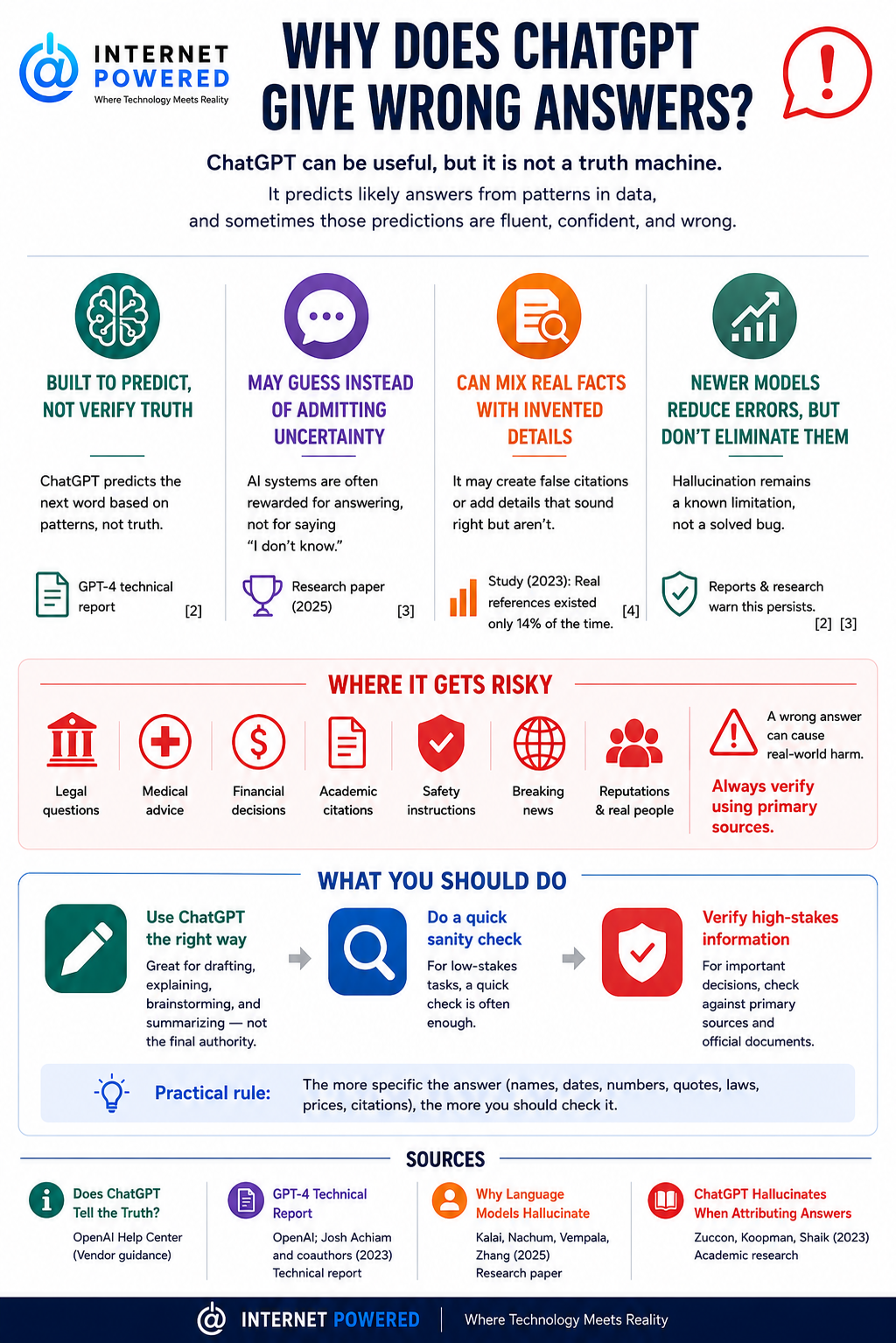
Why Does ChatGPT Give Wrong Answers?
ChatGPT can be useful, but it is not a truth machine. It predicts likely answers from patterns in data, and sometimes those predictions are fluent, confident, and wrong.
Why People Are Asking
People use ChatGPT for work, school, coding, writing, research, customer service, and everyday decisions. That makes wrong answers more than a minor annoyance.
The concern is simple: ChatGPT often sounds confident even when it is mistaken. These errors are commonly called hallucinations — plausible-sounding answers that are inaccurate, unsupported, or fabricated. OpenAI’s own help center says ChatGPT can make mistakes and advises users to check important information. [1]
What We Found
ChatGPT is built to generate likely text, not verify truth
ChatGPT is a large language model. In plain English, that means it learns patterns from text and predicts what words are likely to come next.
That is different from knowing whether something is true.
OpenAI’s GPT-4 technical report describes GPT-4 as a model trained to predict the next token in a document. The same report warns that GPT-4 is not fully reliable and can hallucinate. [2]
It may guess instead of admitting uncertainty
One major reason ChatGPT gives wrong answers is that AI systems are often rewarded for answering, not for saying “I don’t know.”
OpenAI researchers argued in 2025 that language models can hallucinate because training and evaluation systems often reward guessing over acknowledging uncertainty. In other words, the model may produce a confident answer because guessing is often rewarded more than abstaining. [3]
That matters because users often read confidence as competence. A vague answer may look weak. A confident answer may look trustworthy. But confidence is not the same as accuracy.
It can mix real facts with invented details
ChatGPT is especially risky when asked for citations, legal or medical details, recent events, obscure facts, names, dates, quotes, and technical troubleshooting steps.
A 2023 study found that ChatGPT gave correct or partially correct answers in about half of tested cases, but its suggested references actually existed only 14% of the time. The authors also found that even real references often did not support the claims ChatGPT attached to them. [4]
The practical issue is not only that ChatGPT can be wrong. It can be wrong in a way that looks well documented.
Newer models reduce errors, but do not eliminate them
Newer models can improve factual accuracy, but improvement is not the same as reliability without checking.
OpenAI’s GPT-4 technical report said GPT-4 improved on earlier systems in several ways, but it still warned that the model could hallucinate and make reasoning errors. [2]
That pattern continues across the field: hallucination remains an active research problem, not a solved bug. The 2025 paper “Why Language Models Hallucinate” argues that hallucinations persist partly because common evaluations can reward guessing over acknowledging uncertainty. [3]
Reality Check
The evidence supports a balanced view.
ChatGPT is not “just making everything up.” It often gives useful, accurate, and well-structured answers.
But it also does not verify truth the way a person, database, court record, medical chart, or peer-reviewed source can. It can generate a convincing answer without independently proving that the answer is correct. OpenAI’s own guidance reflects this limitation by warning users to verify important information. [1]
The biggest misconception is that a polished answer is a reliable answer. Fluency is one of ChatGPT’s strengths. It is also why mistakes can be hard to spot.
What remains uncertain is how much hallucination can be reduced without making models less useful. OpenAI researchers argue that better evaluations could reward uncertainty more appropriately, but hallucination remains a known limitation. [3]
What You Should Do
Use ChatGPT as a drafting, explaining, brainstorming, and summarizing tool — not as the final authority for important facts.
For low-stakes tasks, it is often fine to use the answer after a quick sanity check.
For high-stakes tasks, verify the answer against primary sources. That includes medical advice, legal questions, financial decisions, academic citations, safety instructions, breaking news, and anything involving real people’s reputations. This advice follows directly from OpenAI’s warning that ChatGPT can make mistakes and that important information should be checked. [1]
A practical rule: the more specific the answer is, the more you should check it. Names, dates, numbers, quotes, laws, prices, and citations deserve extra scrutiny.