
Internet Powered · 21 September 2026
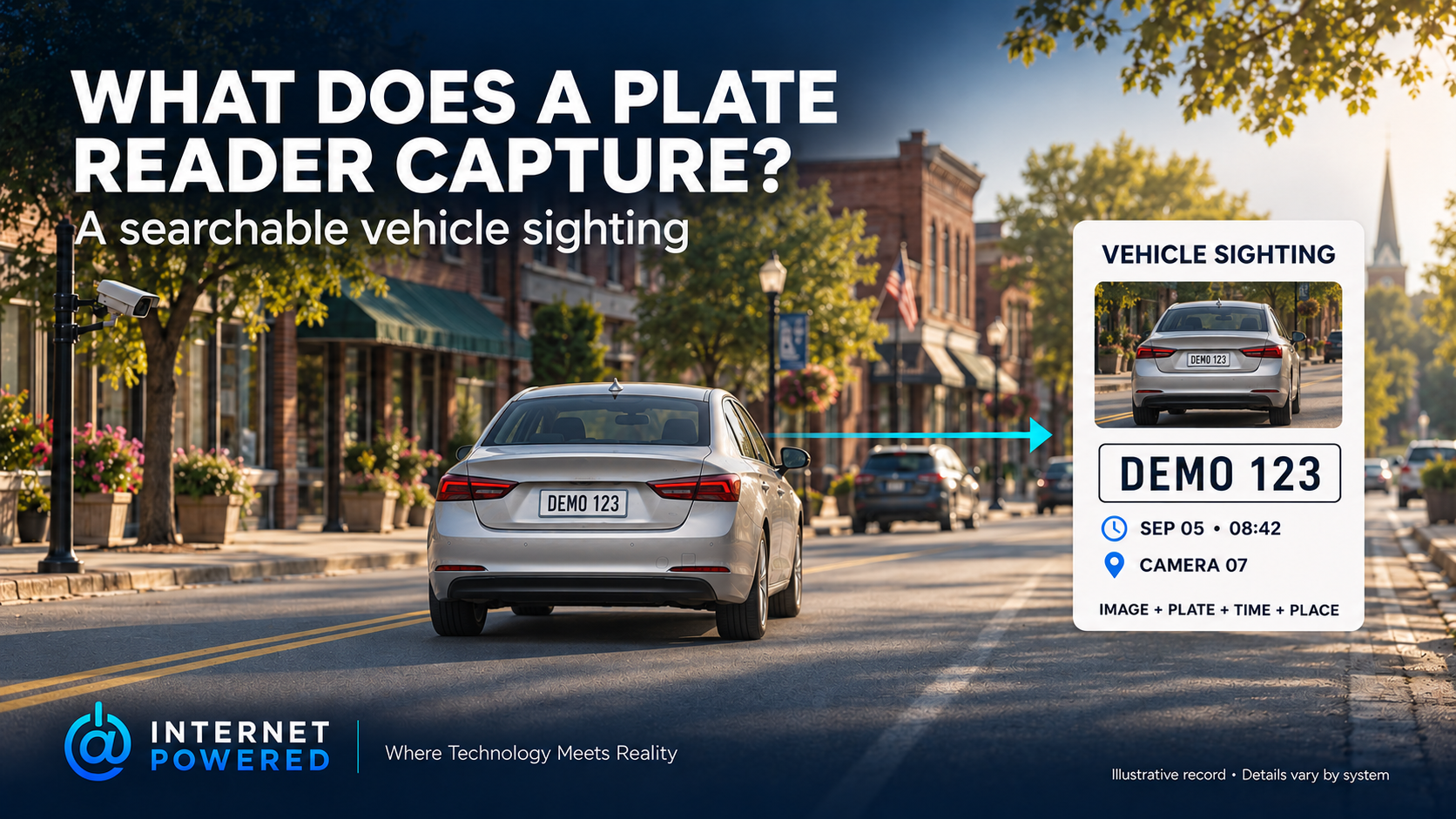
A car passes a roadside camera. For the person driving, it may be an unremarkable moment in an ordinary journey. For the system, it can become a record that someone can find later.
An automated license plate reader creates a searchable vehicle sighting.
That sighting typically combines a plate image, the plate number interpreted by software, and details about when and where the observation happened. It may also include a wider vehicle image. The exact contents depend on the equipment and configuration. [1]
Understanding what the record reveals means following three steps: what the camera captures, what software derives, and what connected information adds.
What the camera captures
The process begins with a photograph. The camera needs a usable view of the license plate, but the image can extend beyond its characters to include the vehicle and some of its surroundings. A system may retain both a close plate image and a wider view. [1]
The name “plate reader” therefore does not guarantee that only the plate appears in the picture. In its 2020 examination of California police systems, the state auditor noted that camera positioning could allow images to include people inside a vehicle. That finding describes a possibility in the systems examined; it does not mean every reader photographs occupants clearly. [2]
What matters at this stage is what the camera can actually see. Angle, distance, lighting, and exposure affect whether a moving plate is readable. An ordinary camera showing passing traffic is not automatically an effective plate reader. [3]
A photograph can contain information that the software never turns into a searchable field. Something being visible and something being automatically identified are separate capabilities.
What software derives and what gives the sighting context
Recognition software finds the plate and converts its visible characters into text. This is called optical character recognition, or OCR. It turns a number in a picture into a number a computer can search. [3]
Imagine looking for the same car in thousands of photographs. A readable plate in each photograph helps a human examine them. A plate number stored as text lets software retrieve matching records. That transformation is what makes the sighting searchable.
Some systems also classify vehicle characteristics. Flock, for example, says its system identifies details such as make, model, and color. Those additional fields describe that vendor’s capabilities; they are not a standard feature list for every plate reader. [4]
The system also attaches context: a timestamp, capture location, and potentially a camera or unit identifier. These details locate the observation. They do not mean the vehicle transmitted its own position to the camera. Together, the image, interpreted plate, time, and location form the basic sighting record. [1]
The distinction between image content and software interpretation matters for people, too. A person appearing in a photograph is different from facial-recognition software identifying them. Flock says its cameras do not use facial recognition; that statement addresses a processing capability, rather than settling everything that could appear in an image. [4]
What connected information adds
Once the plate becomes searchable text, a system can compare it with other information. At a parking entrance, it might check a list of vehicles allowed access. In a police application, it might compare the plate with a list of vehicles of interest and generate an alert. The camera supplies the sighting; the system supplies additional context. [5], [2]
Recording and alerting are separate steps. The police systems described by the California auditor retained sightings even when there was no match to a list. A record could therefore exist without the vehicle having been flagged, ready for a later search. [2]
A person’s name or address can also enter through other records or investigative work. The audit documented personal information being added to some ALPR systems. That information comes from beyond the camera image. Associating a vehicle with a person still does not establish who was driving on a particular occasion. [6]
The same distinction applies to an alert. A match tells someone to examine the result; it does not establish wrongdoing. Covington County’s posted policy, for example, requires visual plate verification and confirmation of alert information. [7]
Why a searchable sighting matters
One record places a vehicle at an observed moment. Several retained, accessible records can reveal parts of its movement history. Connecting those observations with a person can make that history personally revealing. This is an implication of how the records work, bounded by camera coverage, successful readings, retention, and access, not evidence of uninterrupted tracking. A gap between sightings does not show the route taken between them. [1], [6]
For a particular installation, ask what images and searchable fields it retains, how long it keeps them, who can access them, and what other information can be connected.
A plate reader turns a passing vehicle into a searchable sighting. What that sighting reveals depends on the image, the attached details, and the information connected afterward.
Source Library
Sources checked 5 September 2026, as recorded in the research bundle. Publication formatting updated 22 September 2026.
[1] License Plate Reader Policy Development Template
Bureau of Justice Assistance (BJA), host. 2017.
URL: https://bja.ojp.gov/doc/lpr-policy-development-template.pdf
[2] Report 2019-118: Introduction
California State Auditor. 2020.
URL: https://information.auditor.ca.gov/reports/2019-118/introduction.html
Axis Communications. January 2025 version.
URL: https://whitepapers.axis.com/en-us/license-plate-capture
[4] What Do Flock Cameras Actually Capture?
Flock Safety. 2026.
URL: https://www.flocksafety.com/blog/what-do-flock-cameras-actually-capture
[5] AXIS License Plate Verifier: User Manual
Axis Communications. Publication date not stated; online manual.
URL: https://help.axis.com/en-us/axis-license-plate-verifier
[6] Report 2019-118: Audit Results
California State Auditor. 2020.
URL: https://information.auditor.ca.gov/reports/2019-118/auditresults.html
[7] License Plate Readers (LPR)
Covington County, Alabama. Publication date not stated; posted policy.
URL: https://www.covingtoncountyal.gov/315/License-Plate-Readers-LPR