
Is Secure the Same Thing as Private?
A secure service is not automatically a private one.
That is the central idea behind the infographic.
Security and privacy often work together, but they ask different questions. Security asks whether information is protected from unauthorized access, theft, tampering, disruption, or misuse. Privacy asks whether the information should be collected, how it is used, who receives it, how long it is kept, and what it can reveal about people.
A product can be secure and still create privacy risk.
That may sound contradictory, but it is not. A company can protect information from hackers while still collecting more than users expected, using it for advertising, sharing it with partners, retaining it for years, or making sensitive inferences from it.
The information may be locked inside a strong container.
The privacy question is whether it belongs there at all.
Security protects the container
When companies describe a product as secure, they are usually referring to protections against threats.
That may include encrypted connections, password protection, multifactor authentication, secure payment processing, protected storage, fraud detection, software updates, restricted employee access, or breach-response systems.
Those protections matter.
If personal information is collected and then poorly protected, people can be harmed through account takeover, identity theft, credential theft, ransomware exposure, unauthorized employee access, leaked records, altered files, or loss of access to important services.
Security is therefore a foundation of privacy.
A service cannot responsibly collect personal information and then fail to protect it.
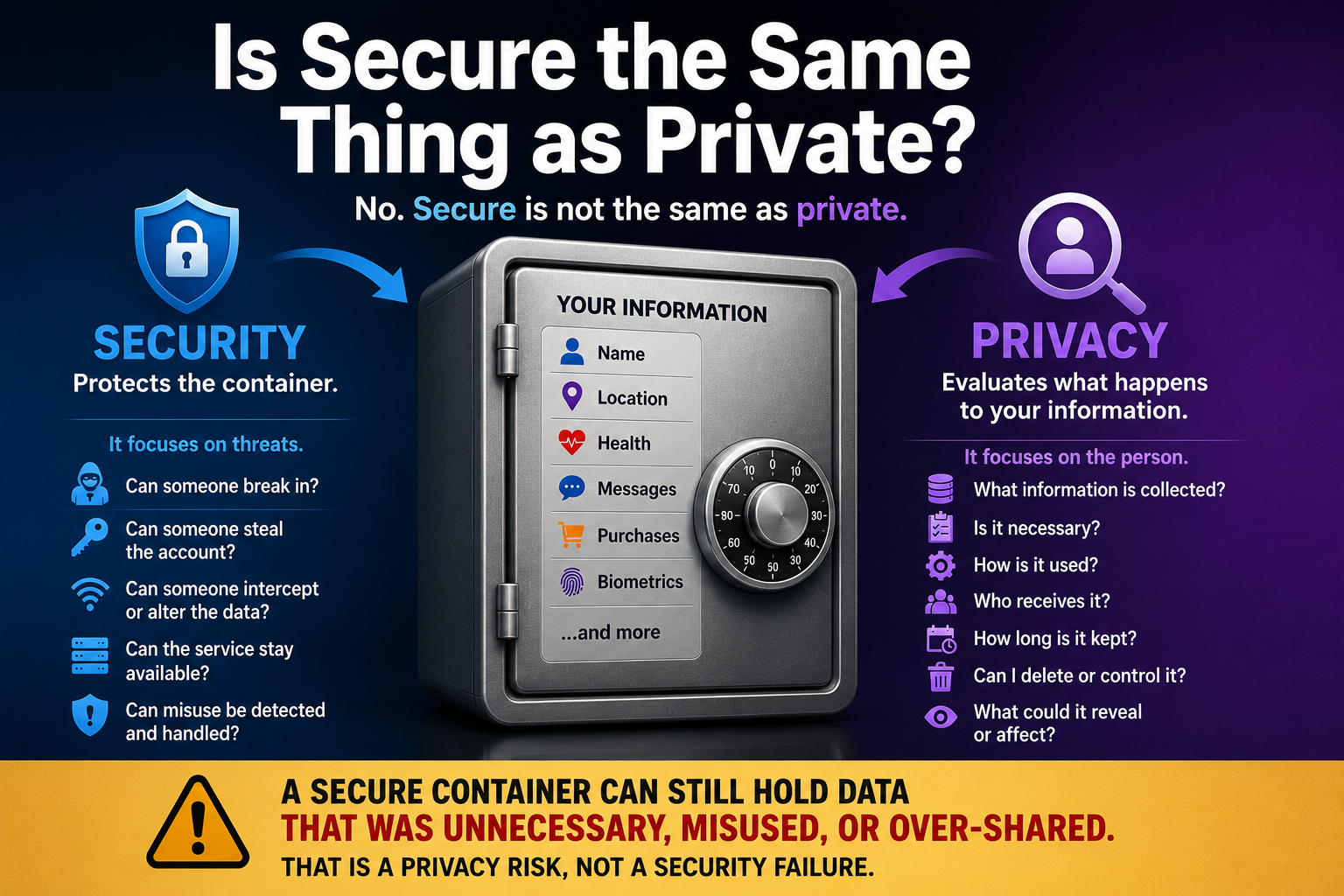
But security mostly answers questions such as:
Can someone break in?
Can someone steal the account?
Can someone intercept or alter the data?
Can misuse be detected and handled?
Those are essential questions. They are not the only questions.
Privacy evaluates the data practice
Privacy asks a broader set of questions about the information itself.
What is collected? Is it necessary? How is it used? Is it shared? Is it retained longer than needed? Can the person delete or control it? Could it reveal something sensitive? Could it affect prices, opportunities, access, reputation, or safety?
These questions still matter even when a system is technically secure.
For example, a fitness app may protect account login and encrypt stored information. But privacy questions remain if it collects location routes, health-related patterns, sleep data, activity levels, or device identifiers and then uses or shares that information in ways users did not expect.
The account may be secure.
The data practice may still be privacy-invasive.
That distinction is why the infographic separates the green security side from the purple privacy side. Security focuses on threats to the container. Privacy focuses on what happens to the information inside it.
A secure container can still hold the wrong data
One of the easiest mistakes is assuming that protected data is automatically appropriate data.
It is not.
A secure database can still hold information that was unnecessary to collect, retained too long, shared too widely, or used for purposes people did not expect.
No breach is required.
A company might securely store purchase history and use it for targeted advertising. A service might securely collect behavioral data across apps. A platform might securely retain information indefinitely. A system might securely infer sensitive traits or personalize prices.
In each case, the security controls may work.
The privacy problem comes from the intended data practice.
That is why the infographic says a secure container can still hold data that was unnecessary, misused, or over-shared. That is a privacy risk, not necessarily a security failure.
Common labels do not answer the whole question
Many privacy misunderstandings begin with accurate labels that users interpret too broadly.
Encrypted means some information is protected in some situation. But it does not automatically answer what is encrypted, who holds the keys, what metadata remains visible, what happens after decryption, or whether the company can still use the information.
Password protected means access to an account is restricted. It does not answer what the service collects after login, whether activity is analyzed, whether information is shared with partners, or how long the data is retained.
Private browsing usually limits what the browser stores locally after a session. It does not necessarily make activity invisible to websites, employers, schools, internet providers, logged-in accounts, analytics systems, or trackers active during the session.
The lesson is not that these features are meaningless.
They are useful. But they are narrower than many people assume.
A product label may describe one protection while users hear a much larger promise.
Privacy can improve security
The relationship also works in the other direction.
Security protects information that exists. Privacy can reduce how much information exists in the first place.
This is where data minimization matters.
The less unnecessary personal information a company collects and keeps, the less information it can expose, misuse, share, or lose.
A company that never collected precise location history, voice recordings, or sensitive identity information cannot later expose those items from its own systems.
This does not mean the information does not exist anywhere else. It means that organization has reduced its own risk and the potential consequences if its systems fail.
Privacy is not just protected by security.
Good privacy practices can make security easier.
Security can also create privacy tradeoffs
Security measures are often legitimate, but they can still raise privacy questions.
A service may ask for government identification or facial images to prevent fraud. That may reduce impersonation, but it also creates sensitive identity records that must now be protected and governed.
A platform may monitor behavior to detect account takeover or payment fraud. That may improve security, but it can also create opaque behavioral profiles or risk scores.
An employer may monitor devices, email, locations, networks, or logins to protect systems. That may help prevent data theft, but it can also capture personal activity and create detailed workplace surveillance.
A security purpose can be real and still require limits.
The privacy question is whether the collection or monitoring is necessary, proportionate, transparent, and appropriately controlled.
Everyday examples show the difference
A secure checkout page may protect payment information during a transaction. But the retailer may still collect purchase history, searches, abandoned carts, device identifiers, discount behavior, product interests, or referral sources for recommendations, targeting, or analytics.
An encrypted messaging app may protect message content in transit. But privacy questions may remain about backups, metadata, contacts, notifications, linked devices, or what recipients can do after receiving a message.
A smart home camera may encrypt video uploads and protect login with multifactor authentication. But privacy questions remain about constant recording, audio capture, human review, law-enforcement access, retention, and whether visitors or household members have meaningful control.
In each case, security asks whether the information is protected.
Privacy asks whether the collection and use are appropriate.
What the evidence supports
The evidence supports a clear conclusion:
Security and privacy are related, but they are not the same.
Security safeguards are necessary for protecting retained personal information. Weak security can destroy privacy.
But privacy problems can also arise from ordinary data processing, not only from breaches or attacks. A company can collect, use, share, infer from, retain, or combine information in ways that affect people even if no outsider breaks in.
The strongest summary is:
Security protects the container. Privacy evaluates what happens to your information.
A secure service can still collect too much, share too widely, retain too long, or use information in ways people did not expect.
Sources
NIST Privacy Framework
Organization: National Institute of Standards and Technology
https://www.nist.gov/privacy-framework
NIST Cybersecurity Framework 2.0
Organization: National Institute of Standards and Technology
https://www.nist.gov/cyberframework
OECD Privacy Principles
Organization: Organisation for Economic Co-operation and Development
https://www.oecd.org/en/topics/privacy-principles.html
Protecting Personal Information: A Guide for Business
Organization: Federal Trade Commission
https://www.ftc.gov/business-guidance/resources/protecting-personal-information-guide-business
Mobilewalla Enforcement Action
Organization: Federal Trade Commission
Published: December 2024
https://www.ftc.gov/news-events/news/press-releases/2024/12/ftc-takes-action-against-mobilewalla-collecting-selling-sensitive-location-data
COPPA Rule Update
Organization: Federal Trade Commission
Published: January 2025
https://www.ftc.gov/news-events/news/press-releases/2025/01/ftc-finalizes-changes-childrens-privacy-rule-limiting-companies-ability-monetize-kids-data
OECD Privacy Principles
Organization: Organisation for Economic Co-operation and Development
https://www.oecd.org/en/topics/privacy-principles.html
Protecting Personal Information: A Guide for Business
Organization: Federal Trade Commission
https://www.ftc.gov/business-guidance/resources/protecting-personal-information-guide-business
Mobilewalla Enforcement Action
Organization: Federal Trade Commission
Published: December 2024
https://www.ftc.gov/news-events/news/press-releases/2024/12/ftc-takes-action-against-mobilewalla-collecting-selling-sensitive-location-data
COPPA Rule Update
Organization: Federal Trade Commission
Published: January 2025
https://www.ftc.gov/news-events/news/press-releases/2025/01/ftc-finalizes-changes-childrens-privacy-rule-limiting-companies-ability-monetize-kids-data