
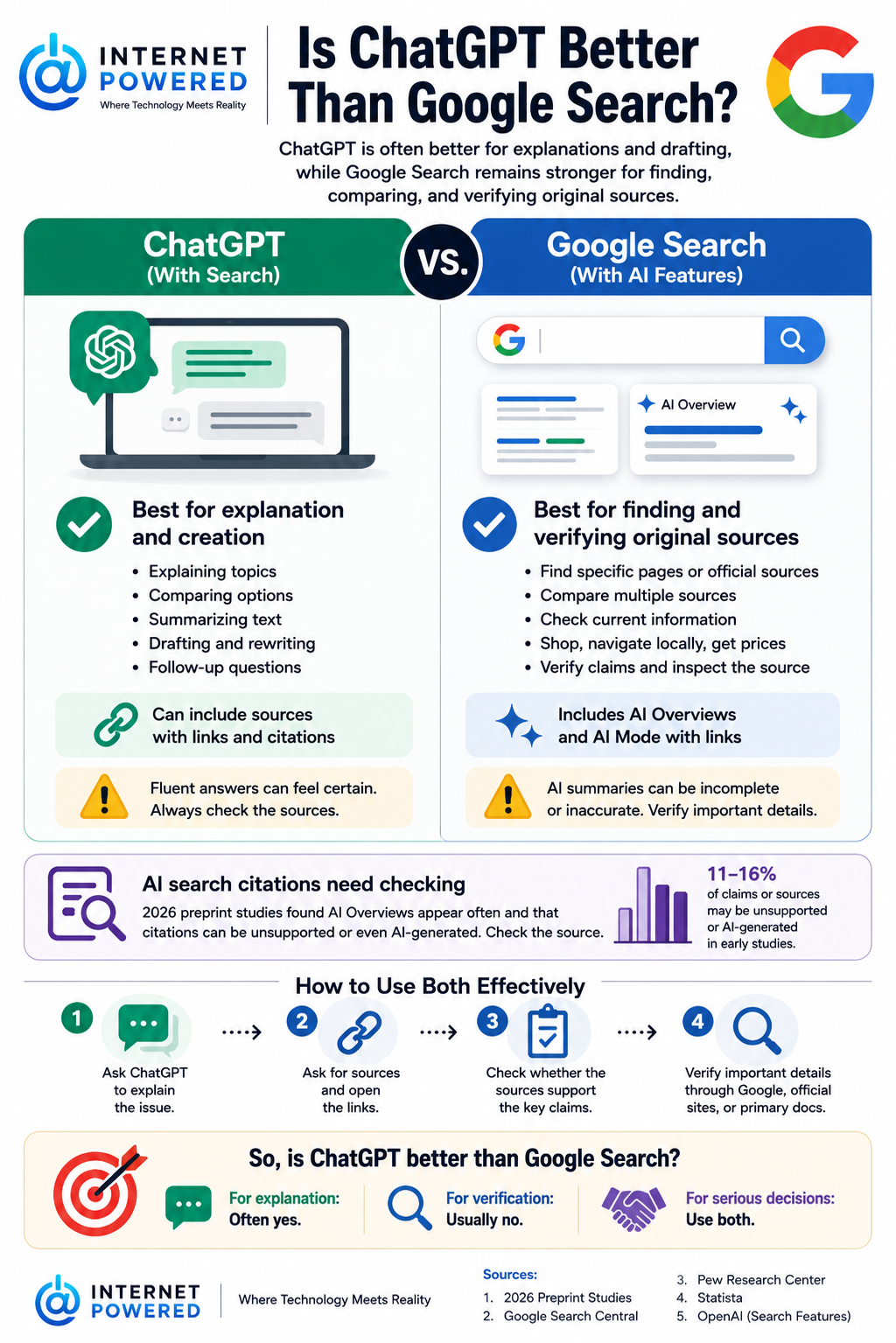
Is ChatGPT better than Google Search?
ChatGPT is often better for explanations and drafting, while Google Search remains stronger for finding, comparing, and verifying original sources.
Why People Are Asking
People are asking this because search is changing.
Google is no longer just a list of links. It now includes AI Overviews and AI Mode, which can summarize information directly in search results. Google describes AI Overviews as AI-generated snapshots with links for deeper reading. [3]
ChatGPT has moved in the other direction. It is no longer only a chatbot trained on earlier information. OpenAI introduced ChatGPT Search in October 2024, saying it could provide timely answers with links to relevant web sources. [1] OpenAI’s help documentation also says ChatGPT responses that use search may include inline citations users can open to inspect the source. [2]
That means the old distinction — “Google gives links, ChatGPT gives answers” — is less clear than it used to be.
What We Found
ChatGPT is better suited for explanation
ChatGPT’s main advantage is that it can turn a broad or confusing question into a readable answer.
That makes it useful for explaining a topic, comparing options, summarizing text, rewriting an email, or helping someone think through a decision.
This is especially helpful when the user does not yet know the right search terms. Instead of requiring a perfect keyword query, ChatGPT can respond conversationally and adjust as the user asks follow-up questions.
However, that strength also creates a risk. A fluent answer can feel more certain than it deserves to be. Even when ChatGPT includes citations, the user still needs to check whether the sources actually support the claims. OpenAI describes search responses as something that may include citations, not as a guarantee that every answer is complete or correct. [2]
Google Search is stronger when you need the source itself
Google Search is often the stronger starting point when the goal is to find a specific page, compare multiple sources, check official guidance, shop, navigate locally, or verify a claim. [4]
That does not mean Google Search is neutral or perfect. Search results can be incomplete, ranked by systems users cannot fully see, shaped by ads, and affected by personalization.
But when the goal is to inspect the source directly, Google still gives users more control over which pages they open and compare.
That matters for real-world decisions. If someone needs tax rules, medical guidance, a government form, a product price, a local business hour, or the latest news, the original source is usually more important than a summarized answer.
Google is also integrating AI into that process. Its Search Central documentation says AI Overviews and AI Mode are part of Google Search and describes them from the perspective of website owners whose content may appear in those experiences. [5] In May 2026, Google described a broader move toward AI-powered Search features, including more advanced AI capabilities inside Search. [6]
AI search tools can be useful, but their citations still need checking
The strongest caution is not that AI search is useless. It is that AI-generated summaries can separate readers from the evidence.
A 2026 preprint studying Google AI Overviews reviewed 55,393 trending queries and reported that AI Overviews appeared for 13.7% of queries overall and 64.7% of question-form queries. The same study found that 11.0% of the atomic claims it examined were unsupported by the cited pages. Because this is a preprint, it should be treated as preliminary evidence rather than settled fact. [7]
Another 2026 preprint comparing Google Search, Google AI Overviews, and Gemini found that AI Overviews appeared for 51.5% of representative real-user queries in its dataset. It also found that AI-generated search results could rely on substantially different sources than traditional search results. This also remains preprint evidence, but it supports the broader caution that AI search does not simply reproduce traditional search rankings. [8]
A separate 2026 preprint auditing generative search citations across ChatGPT, Copilot, Gemini, and Perplexity found evidence that AI-generated sources were cited by all four systems in the study. The authors reported that about 16% of cited sources showed evidence of being AI-generated. That does not mean every AI citation is unreliable, but it does mean users should not treat citations as automatic proof. [9]
These studies are useful because they examine real search behavior and citation support. But they are also snapshots of fast-changing products. Their findings may vary by region, query type, account settings, and future product updates. [7] [8] [9]
Reality Check
ChatGPT is not simply “better” than Google Search. It is better at some jobs and worse at others.
The available evidence supports this practical distinction, though it does not amount to a universal benchmark of ChatGPT versus Google across every kind of query. [7] [8] [9]
ChatGPT is useful when the user wants an explanation, summary, draft, or guided reasoning. Google Search is usually better when the user needs to inspect original sources, compare results, or verify details. [1] [2] [4]
The evidence does not support treating either tool as flawless. Google’s AI results can summarize information in ways that need checking. ChatGPT’s search-enabled answers can include citations, but users still need to confirm that the cited sources are relevant, current, and authoritative. [2] [3] [7] [8] [9]
The bigger change is that both products are converging. Google is adding AI summaries and AI Mode. ChatGPT is adding web search and source links. The choice is becoming less about “AI versus search” and more about how much control the user wants over source selection and verification. [1] [2] [3] [5] [6]
What You Should Do
Use ChatGPT first when you want to understand something, simplify a topic, compare options, draft text, or ask follow-up questions. [1] [2]
Use Google Search first when you need an official source, current information, local details, prices, legal rules, medical guidance, financial information, product availability, or direct access to webpages. [4] [5]
For important decisions, the safest workflow is:
Ask ChatGPT to explain the issue. Then ask for sources. Open the original sources, check whether they actually support the key claims, and verify important details through Google, official websites, or primary documents. [2] [4] [7] [8] [9]
So, is ChatGPT better than Google Search?
For explanation, often yes. For verification, usually no. For serious decisions, the better answer is to use both.