
How Secure Is Messaging with Signal?
Signal is one of the strongest widely available tools for protecting private messages, but its strength comes from a specific design choice: it removes as many trusted intermediaries as possible.
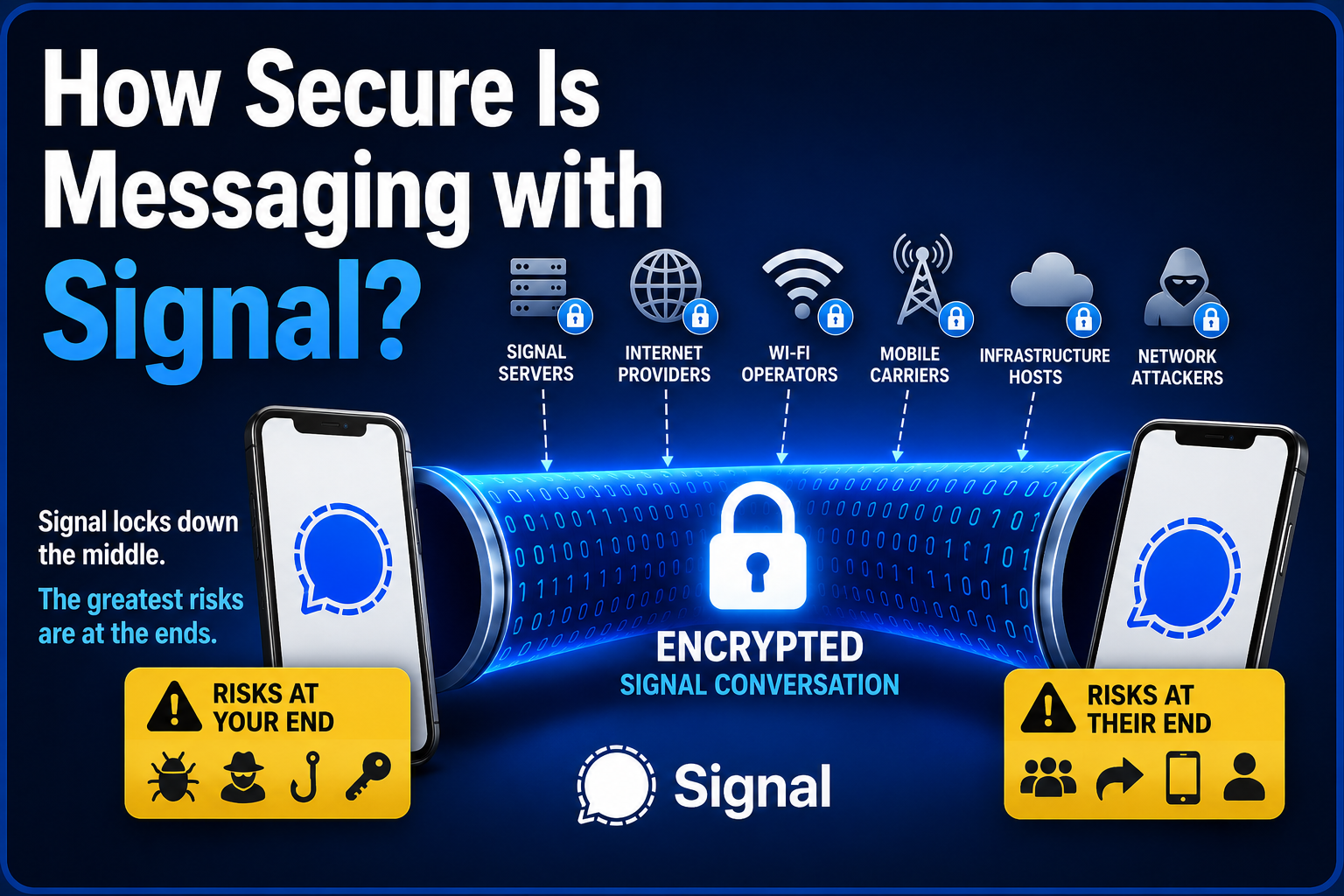
That is the main idea behind the infographic.
When you send a Signal message, the content is encrypted on your device and decrypted only on participating devices. Signal’s servers help deliver the message, but they are not supposed to be able to read it. Internet providers, Wi-Fi operators, mobile carriers, infrastructure hosts, and network attackers are also locked out of the message content.
That is why Signal provides unusually strong protection for the middle of the communication path.
But the middle is not the whole conversation.
Signal protects the path
Signal uses end-to-end encryption for messages and calls by default. There is no ordinary unencrypted Signal conversation mode that users must remember to turn off.
That matters because privacy does not depend on choosing the right setting each time. The service is designed so that message and call content is encrypted before it reaches Signal’s servers.
This protects against many common threats, including network interception and service-side access to message content.
It also means Signal generally cannot provide readable message content it does not possess.
That is different from a service that merely promises not to look at messages. Signal’s stronger claim is architectural: the system is designed so the service cannot decrypt them.
A policy can change. A technical inability to access information provides stronger protection.
Signal also tries to know less
End-to-end encryption protects the content of messages and calls. Signal also tries to minimize the information its own service can access.
Its design includes protections for profiles, groups, contact discovery, and sender information. Signal’s published legal-demand responses are consistent with the idea that it retains very limited account information and no decryptable message content.
That does not mean Signal knows literally nothing.
The service still needs some operational information to register accounts, route encrypted messages, maintain connections, and prevent abuse. It may have limited records such as account creation or recent connection dates.
The important distinction is that Signal is designed to retain very little compared with many communication services.
Signal reduces the need to trust the service and the network. It does not eliminate every form of trust.
The endpoints are the main risk
Every secure message eventually has to become readable somewhere.
That somewhere is the endpoint: the sender’s device, the recipient’s device, or a linked computer or tablet.
Once a message is decrypted on an authorized device, Signal’s encryption has done its job. From that point forward, practical privacy depends on the security of the device and the behavior of the people using it.
A securely delivered Signal message can still be exposed by:
- An unlocked phone
- A weak or shared passcode
- A forgotten linked desktop
- Malware or spyware
- A compromised computer
- Lock-screen notifications
- A shared device
- A recipient’s screenshot or photo
None of these necessarily means Signal’s encryption failed.
The message may have traveled securely and then appeared on a device someone else could access.
That is the meaning of the key takeaway:
The strongest encryption cannot protect plaintext on a device controlled by someone else.
Identity still matters
Encryption protects a conversation with a cryptographic endpoint. It does not automatically prove that the endpoint belongs to the person you think it does.
That is why Signal provides safety numbers and QR-code verification.
For ordinary conversations, many users may never check them. For sensitive conversations, verification matters because it helps confirm that the devices participating in the conversation match the intended people.
A changed safety number does not automatically mean an attack occurred. It may happen when someone changes phones, reinstalls Signal, or re-registers an account.
But it is still a signal that the cryptographic identity changed.
For highly sensitive conversations, that change should be checked before continuing.
Phone-number takeover is a future-message risk
Signal registration is still associated with a phone number.
If an attacker takes control of that number, they may try to register it on another device. Signal’s PIN and Registration Lock can make that harder.
A phone-number takeover does not automatically transfer the old message history from the original device.
That is an important limit.
But it can create a future-delivery and impersonation risk. Contacts may begin sending new messages to the attacker’s newly registered device if they do not notice that something changed.
This is why account registration and identity verification are part of practical Signal security.
Backups create a tradeoff
Signal now offers optional encrypted backups.
That improves recovery if a user loses or replaces a device. But any backup also creates another stored copy of message history.
Signal says Secure Backups are end-to-end encrypted and protected by a recovery key the user controls. Signal cannot restore the backup if that recovery key is lost.
This preserves Signal’s security model, but it creates a responsibility for the user.
A recovery key stored in an unsecured note, screenshot, printed sheet, or poorly protected location can become the weak point.
The tradeoff is simple:
More recoverability means another copy that must remain protected.
Disappearing messages are not guaranteed deletion
Disappearing messages are useful, but they are often misunderstood.
They can reduce how long messages remain in Signal conversation histories. That may lower the risk of old messages being exposed later through a stolen, searched, or inspected device.
But disappearing messages do not control the recipient.
A recipient can screenshot a message, photograph the screen, copy the text, forward the information, or preserve it with another device before it disappears.
The same basic limitation applies to view-once media.
The clearest description is:
Disappearing messages are a retention control, not remote control.
They reduce accumulation. They do not guarantee that no copy exists.
Recipients remain outside Signal’s control
Signal can prevent outsiders and Signal itself from reading message content in transit. It cannot make every recipient trustworthy.
Once a recipient receives and decrypts a message, that person can save, copy, forward, quote, photograph, or disclose it.
Group conversations expand this risk. Every participant and every linked device becomes another authorized endpoint.
A group can be encrypted from outsiders while still being only as private as the people and devices inside it.
This is not a weakness unique to Signal. It is a limit of all messaging systems.
Encryption controls the route. It does not control human behavior.
What the evidence supports
The evidence supports describing Signal as a high-security, privacy-preserving messaging service with important real-world limits.
Signal strongly protects message and call content in transit. It is designed so that even Signal cannot read that content. It also minimizes much of the information its servers can access.
But Signal is not magic.
It does not make users anonymous. It does not make infected phones safe. It does not stop recipients from preserving messages. It does not guarantee that identities are correct unless users verify them. It does not make backups risk-free. It does not prevent social engineering.
The strongest conclusion is:
Signal removes many trusted intermediaries from the trust chain. It cannot remove the need to trust the devices and people at each end.
Sources
Is It Private? Can I Trust It?
Organization: Signal
https://support.signal.org/hc/en-us/articles/360007320391-Is-it-private-Can-I-trust-it
Signal Protocol Specifications
Organization: Signal
https://signal.org/docs/
Formal Security Analysis of the Signal Messaging Protocol
Authors: Katriel Cohn-Gordon and collaborators
https://ftp.kr-labs.com.ua/books/A-Formal-Security-Analysis-of-the-Signal-Messaging-Protocol.pdf
Formal Analysis of Session Handling in Secure Messaging
Publication: USENIX Security research
Published: 2023
https://www.usenix.org/system/files/usenixsecurity23-cremers-session-handling.pdf
Signal Government Communication Archive
Organization: Signal
https://signal.org/bigbrother/
Sealed Sender
Organization: Signal
Published: October 29, 2018
https://signal.org/blog/sealed-sender/
Signal PIN and Registration Lock
Organization: Signal
https://support.signal.org/hc/en-us/articles/360007059792-Signal-PIN
Disappearing messages documentation
Organization: Signal
https://support.signal.org/hc/en-us/articles/360007320771-Set-and-manage-disappearing-messages
NVD CVE-2025-5715
Organization: National Institute of Standards and Technology, National Vulnerability Database
Published: June 2025
https://nvd.nist.gov/vuln/detail/CVE-2025-5715