
How Does My Watch Count My Steps?
A smartwatch can report a surprisingly precise number of steps. Seeing a total like 8,427 naturally gives the impression that the watch detected exactly 8,427 individual footsteps. That assumption becomes harder to maintain when pushing a shopping cart causes steps to disappear, folding laundry adds unexpected ones, or two watches report different totals for the same walk.
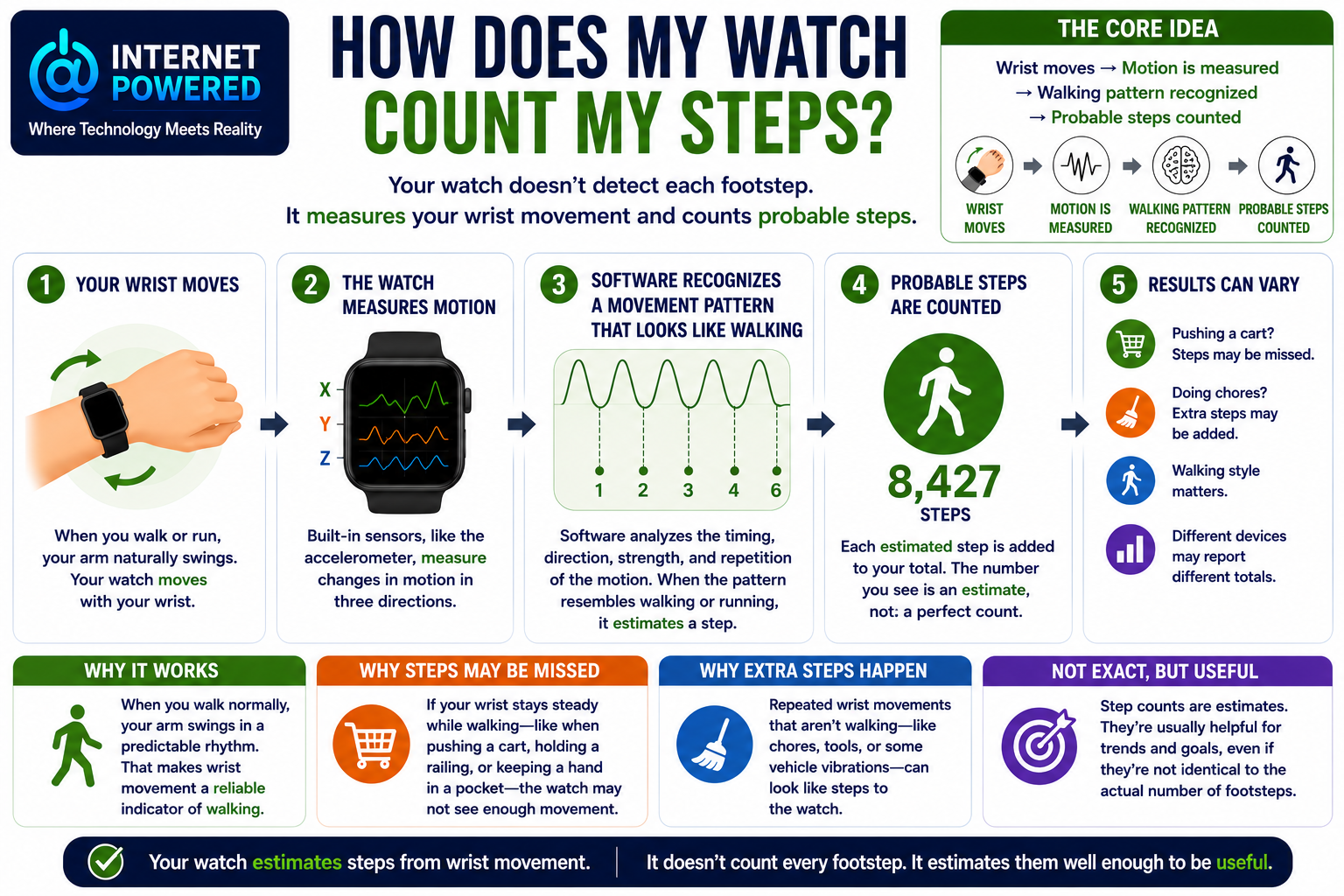
The explanation is that a smartwatch is not observing your feet directly. Instead, it measures how your wrist moves and uses software to decide whether that pattern of movement resembles walking or running. Once that distinction is understood, many of the quirks of step counting become much easier to explain. How Does My Watch Count My Steps?
Measuring Motion Is Not the Same as Counting Steps
The most useful way to understand step counting is to separate measurement from interpretation.
The watch measures motion. The software decides whether that motion looks like walking.
The primary sensor responsible for this process is a three-axis accelerometer. Rather than detecting footsteps, the accelerometer measures how the watch accelerates as your wrist moves in different directions. These measurements create a continuous stream of motion data, but none of that information is labeled as a "step." It simply describes how the watch is moving.
The watch collects the measurements. The software must determine what those measurements mean.
Software Looks for Walking Patterns
Once motion has been measured, software analyzes the timing, direction, strength, repetition, and overall pattern of your wrist's movement. Instead of asking whether a foot touched the ground, the software is effectively asking a different question: does this pattern of wrist movement resemble ordinary walking or running?
A single arm movement usually does not provide enough evidence to count as a step. A repeating rhythm of movement is much more convincing. When enough evidence is present, the software records a probable step.
This is why the number displayed on the screen is an estimate rather than a direct count of every footfall.
Why Wrist Movement Usually Works
Although your watch never observes your feet directly, wrist movement often provides a useful clue because your arms and legs naturally move together while you walk.
During normal walking, your arms tend to swing in a predictable rhythm that corresponds with your stride. Because that relationship is usually consistent, wrist movement becomes a practical indirect indicator of walking. The watch does not need to see each foot touch the ground if the motion of your wrist reliably reflects that movement.
This indirect approach allows smartwatches to estimate steps surprisingly well during everyday walking and running.
Why Steps Are Sometimes Missed
The same approach that makes wrist-based step counting possible also creates its biggest limitation.
If you continue walking while the arm wearing the watch remains relatively still, the software may no longer recognize enough evidence of walking. This commonly happens while pushing a shopping cart or stroller, carrying a box or child, holding a handrail, keeping a hand in a pocket, or using a cane or walker.
In each of these situations, your feet continue taking real steps, but your wrist no longer produces the motion pattern the software expects to see. As a result, genuine steps may not be counted.
Why Extra Steps Sometimes Appear
The opposite situation can also occur.
Repeated wrist movements that are not caused by walking may sometimes resemble a walking pattern closely enough to satisfy the software. Household chores, tool use, repeated gestures, or certain vehicle vibrations can occasionally produce motion that looks similar to walking.
The software attempts to distinguish these activities from actual steps, but no pattern-recognition system can perfectly separate every wrist movement from every possible walking motion. As a result, some non-walking movements may occasionally be added to the step total.
Your Walking Style Matters
Step counting works best when your walking pattern closely matches the movements the software expects to recognize.
Very slow walking, short shuffling steps, irregular gait, or limited arm swing can all make step recognition more difficult. Research comparing wrist-worn devices with other measurement methods shows that accuracy varies depending on walking speed, the activity being performed, and where the sensor is worn.
This does not mean the watch is malfunctioning. It simply means that some walking patterns produce weaker or less consistent motion signals than others.
Other Sensors Have Different Jobs
Although the accelerometer provides the primary evidence for step counting, modern smartwatches often include additional sensors such as GPS, gyroscopes, heart-rate sensors, and barometric altimeters.
These sensors improve related measurements such as distance, pace, route, elevation, or workout tracking. They do not replace the accelerometer as the primary source for estimating steps.
This also helps explain why step count and distance are different measurements. Step count estimates how many walking movements occurred. Distance estimates how far you traveled, often using stride length, GPS calibration, or both. A watch may estimate steps reasonably well while producing a less accurate distance estimate, or improve its distance calculations without changing how it recognizes individual steps.
Why Different Watches Can Produce Different Results
People are often surprised when two watches report different totals for the same walk. That does not necessarily mean one device is correct and the other is wrong.
Different manufacturers use different sensors, software, calibration methods, thresholds, and pattern-recognition algorithms. Because these systems are proprietary, companies generally do not publish the exact rules their devices use when deciding whether a particular movement qualifies as a step.
When the evidence is clear, different watches often reach similar conclusions. When the movement is less certain, however, different devices may make different decisions about whether a probable step occurred.
Understanding Your Step Count
Many people imagine that a smartwatch counts each time a foot touches the ground. The evidence supports a different mental model.
A smartwatch measures how your wrist moves. Software analyzes that motion to determine whether it resembles walking. When the movement matches the expected pattern, the watch records a probable step.
When the relationship between wrist movement and walking remains strong, the estimate is often quite useful. When that relationship changes, the watch may miss genuine steps or count movements that were not steps at all.
Keeping three questions in mind helps explain most everyday differences in step counts:
- What did the watch actually measure?
- Did your wrist move the way it normally does while walking?
- Could another movement have looked similar enough to be counted as a step?
Those questions reinforce the publication's central idea: the watch measures your wrist, and the software estimates your steps.
The number on your watch is best understood as a carefully calculated estimate rather than an exact tally of every footstep. The watch measures your wrist, and the software estimates your steps.