
How Did ChatGPT Come Up With That Answer?
At first glance, ChatGPT can seem almost magical. You ask a question, and within seconds it produces a detailed explanation, writes computer code, summarizes a document, or drafts an email. It’s easy to imagine that it searched through a hidden database, found the right answer, and simply displayed it.
But that’s not how ChatGPT works.
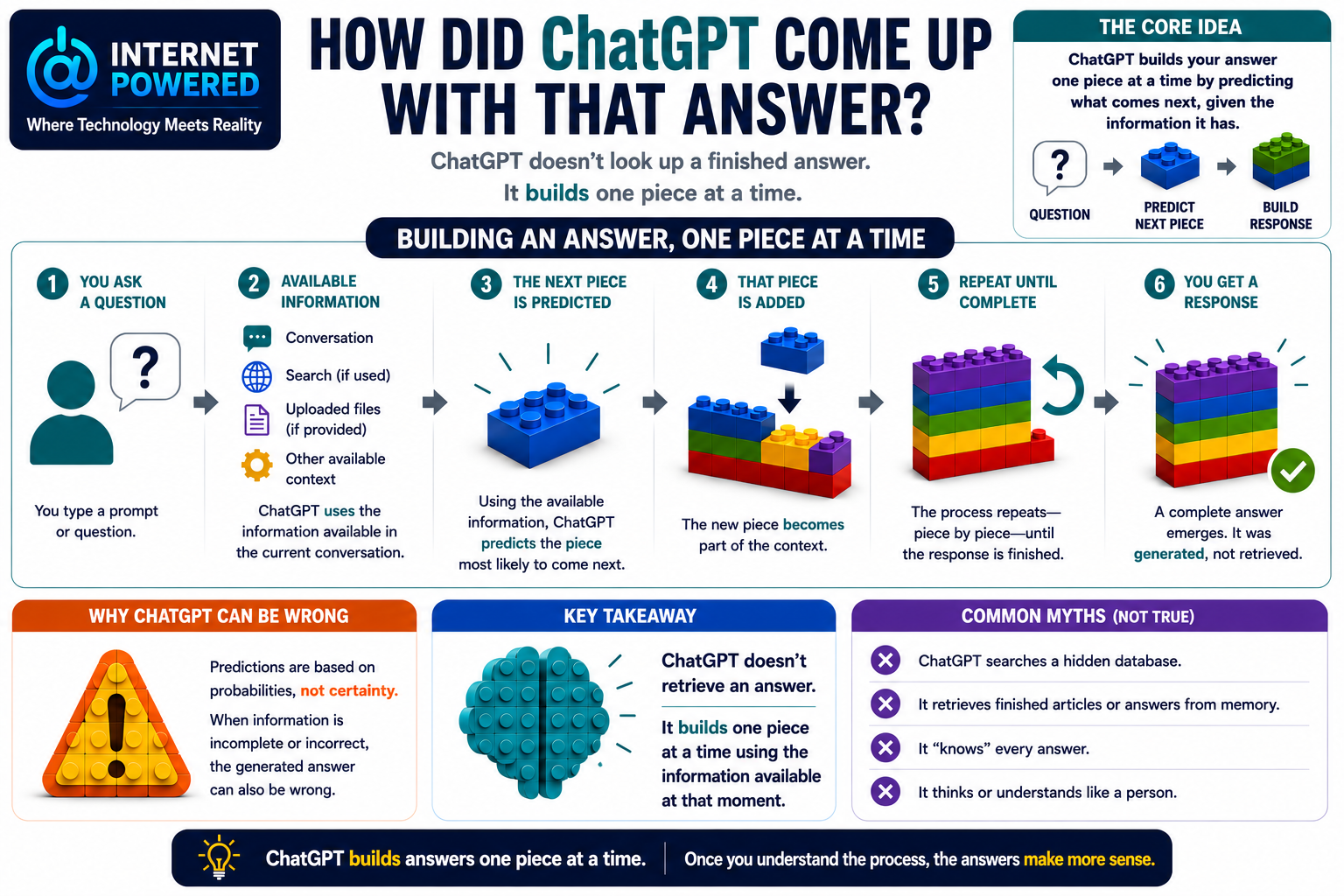
As the infographic explains, ChatGPT doesn’t retrieve a finished answer. It builds one piece at a time.
Understanding that single idea, makes many of ChatGPT’s strengths and limitations much easier to understand.
Building Instead of Retrieving
Most people are familiar with search engines. You enter a question, the search engine looks through an index of web pages, and it returns links to information that already exists.
ChatGPT follows a different process.
Instead of searching for a completed paragraph, it begins with the information available in the current conversation and predicts what should come next. It generates one small piece of text, adds that new piece to the conversation, and then predicts the next one. This cycle repeats until the response is complete.
You can think of it like building with blocks. One block doesn’t look like much on its own, but as each new block is added, a larger structure begins to take shape. The finished answer emerges from many small predictions rather than being pulled from storage as a finished product.
The Information Available Right Now
Every prediction depends on the information ChatGPT has available at that moment.
That includes your current question, the earlier messages in the conversation, and when they’re used, additional sources such as uploaded documents, web search results, or specialized tools. If memory is enabled and relevant, previously remembered information may also become part of the available context.
This explains why changing even a few words in your prompt can produce a noticeably different response. A different prompt creates different context, and different context changes what the model predicts next.
Prompting isn’t a trick or a secret technique. It’s simply one of the main ways users shape the information available during generation.
Learning Patterns, Not Memorizing Answers
A common misconception is that ChatGPT contains a giant encyclopedia hidden inside it.
The research supports a different picture.
During training, the model processed enormous amounts of text and repeatedly learned to predict the next token (the next piece of text), given everything that came before it. Over time, billions of internal numerical parameters were adjusted to improve those predictions.
Those parameters are not stored articles or facts. They represent learned relationships within language: how words, ideas, and concepts tend to appear together.
Rather than memorizing finished explanations, the model learns patterns that allow it to generate new ones.
Why ChatGPT Sounds Like a Teacher
Many ChatGPT responses follow a familiar structure. A question is answered with a definition, followed by an explanation, an example, and a conclusion.
That doesn’t mean the model found a previously written lesson.
Instead, it reflects the patterns the model learned during training. Human explanations often follow similar structures, so ChatGPT naturally generates responses that resemble articles, classroom lessons, or conversations.
The result feels familiar because the model has learned the statistical patterns of explanatory writing, not because it is copying a stored document.
Why Web Search and Uploaded Files Improve Answers
When ChatGPT uses web search or analyzes an uploaded document, it doesn’t stop being a language model.
Instead, those resources provide additional information for the generation process.
Web search can supply recent or external information that wasn’t already available. Uploaded files give the model access to documents specific to your conversation. The model still builds the answer one piece at a time. It simply has better information to work with.
This is an important distinction. Search provides evidence. ChatGPT generates the response.
Why ChatGPT Can Be Wrong
The infographic also explains why ChatGPT sometimes produces convincing but incorrect answers.
Because the model predicts what is most likely to come next, it is optimizing for probable continuations, not guaranteed truth. When the available information is incomplete, outdated, or ambiguous, the prediction process can produce statements that sound confident but are inaccurate.
These mistakes are generally prediction failures rather than intentional deception.
Understanding this helps explain why two ideas can both be true:
- ChatGPT often produces remarkably useful explanations.
- Important information should still be verified using reliable sources when accuracy matters.
A Better Way to Think About ChatGPT
Rather than asking, “Where did ChatGPT find that answer?” it’s more accurate to ask, “What information did ChatGPT have available when it built this answer?”
That simple shift explains many of the behaviors people observe every day.
A different prompt changes the available context.
An uploaded document changes the available context.
Web search changes the available context.
New information later in the conversation changes the available context.
And because each prediction depends on that context, the response changes too.
ChatGPT doesn’t search a hidden database or retrieve finished answers from memory. It generates each response one piece at a time by predicting what is most likely to come next using patterns learned during training and the information available in the current conversation.
Sources
OpenAI — Introducing ChatGPT
https://openai.com/index/chatgpt/
November 30, 2022
OpenAI — GPT-4 Technical Report
March 15, 2023
OpenAI — Language Models are Few-Shot Learners (GPT-3)
https://arxiv.org/abs/2005.14165
May 28, 2020
OpenAI — Learning to Reason with LLMs (OpenAI o1)
https://openai.com/index/learning-to-reason-with-llms/
September 12, 2024
“Attention Is All You Need”
https://arxiv.org/abs/1706.03762
June 12, 2017
Stanford Human-Centered AI — Foundation Models
https://hai.stanford.edu/focus-area/foundation-models
Google Research — The Illustrated Transformer (educational reference)
https://jalammar.github.io/illustrated-transformer/
June 27, 2018