
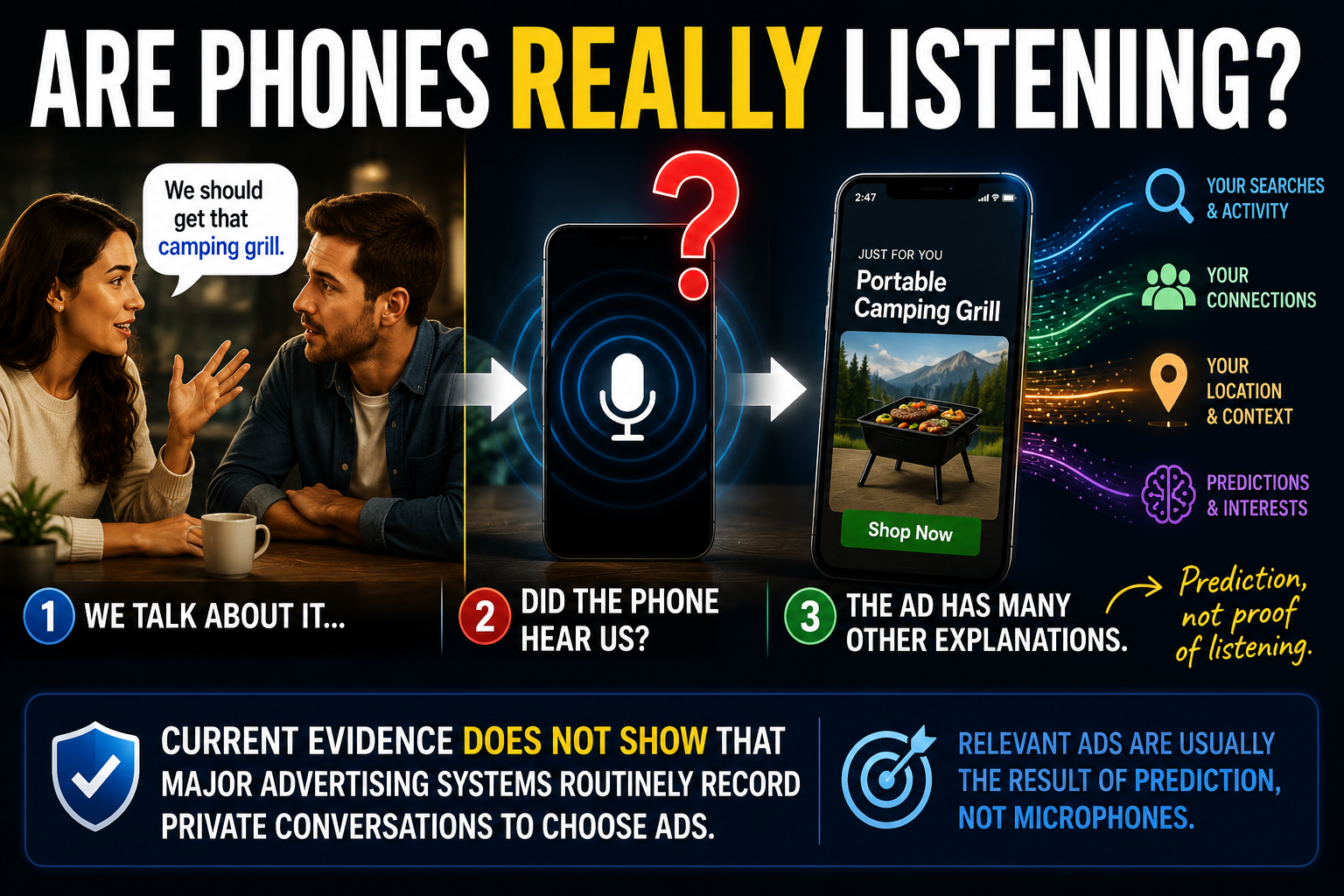
Are Phones Really Listening?
Few privacy questions feel more personal than whether your phone is secretly listening to you.
A person mentions a product, destination, medical concern, or unusual hobby, then sees a related advertisement soon afterward. The timing can feel too precise to be random, especially when the person does not remember searching for the subject.
But the phrase “my phone is listening” combines several different claims. Separating them is the key to understanding what the evidence does and does not show.
Phones really do use microphones
Phones unquestionably use microphones. Calls, voice messages, video recordings, speech-to-text, accessibility tools, music identification, and voice assistants all depend on audio.
Current iPhones and Android devices also provide permission controls and indicators intended to show when an app or service is using the microphone.
That establishes capability and ordinary use. It does not establish continuous secret recording.
A permission means that an app may use the microphone under allowed conditions. It does not prove that the app is recording all the time.
A microphone indicator shows that the microphone was active, but it does not reveal whether the audio was saved, transmitted, transcribed, or used for advertising.
The distinction can be summarized as:
Capability does not prove behavior, and behavior does not prove purpose.
Wake-word detection is not the same as recording everything
Voice assistants add another layer of complexity.
A voice-enabled device must analyze incoming sound enough to recognize an activation phrase such as “Hey Siri,” “Hey Google,” or “Alexa.” Apple has described this as a limited on-device recognition process designed to detect the wake phrase before fuller voice processing begins.
This is one reason the phrase “always listening” can be technically true in a narrow sense while still being misleading in ordinary conversation.
The device is monitoring for a short trigger phrase. That is not the same as continuously uploading or storing every surrounding conversation.
Wake-word systems are also imperfect. Academic researchers have shown that ordinary television dialogue and similar-sounding phrases can accidentally activate smart speakers.
When this happens, speech that was not intended as a command may be captured or processed.
That is a real privacy concern. It is still different from using private conversations to choose advertisements.
Voice-data privacy problems are real
The same distinction applies to documented problems involving stored voice recordings.
In 2023, the Federal Trade Commission and Department of Justice charged Amazon over its handling of children’s Alexa recordings and transcripts. The government alleged that some recordings were retained for years, deletion requests were not fully honored, and unlawfully retained data was used to improve Alexa’s systems.
This case shows that voice data can be stored, retained, and used in ways people do not expect.
It does not show that Alexa recordings were secretly used to select advertisements.
Audio has also been used for advertising-related measurement in more limited ways. In 2016, the FTC warned app developers about SilverPush software, which could use a phone’s microphone to detect ultrasonic codes embedded in television advertisements.
SilverPush did not need to understand conversations. It listened for encoded signals intended to identify that a particular television advertisement had played.
That example proves that microphone-based advertising technology is technically possible. It does not prove that ordinary speech is routinely recorded, transcribed, and added to advertising profiles.
Researchers have looked for covert recording
Independent researchers have also tested whether apps secretly activate microphones.
In the 2018 Panoptispy study, researchers examined 17,260 Android apps and did not observe covert audio transmission under their test conditions. They did find other unexpected media collection, including screen recordings and screenshots.
The study does not prove that no app has ever recorded secretly.
Automated testing cannot reproduce every account, location, server instruction, campaign, or later software version. But the findings weaken the claim that widespread ambient-audio capture was routine across the large app sample examined.
The strongest apparent confirmation did not hold up
The most important recent development is the Cox Media Group “Active Listening” case.
Cox promoted a service that allegedly used conversations captured by smart devices to target advertisements. The claim spread widely because it appeared to confirm what many people already believed.
But the public evidence initially showed only that the company made the claim. It did not show which devices supplied the audio, how users consented, how conversations were transmitted, or whether the system worked as described.
In May 2026, the FTC alleged that Cox Media Group and two other firms had falsely promoted the service. According to the agency, it did not use voice data. It relied instead on email lists obtained from data brokers.
That does not prove that no company has ever misused microphone access.
It does show why a marketing pitch should not be treated as technical evidence.
Advertising systems already have many other signals
The Cox case also points toward a less dramatic explanation for many highly relevant advertisements: advertising systems already collect large amounts of non-audio information.
Searches, website visits, product views, purchases, account activity, location, customer lists, shared household signals, and inferred interests can all influence which advertisements appear.
A family member may have searched for the product. The person may have encountered it earlier without remembering. The advertisement may have been part of a broad campaign or selected from a statistical audience category.
Coincidence also matters.
People see many advertisements and discuss many subjects. A matching advertisement is memorable. The many advertisements that do not match recent conversations usually are not.
None of these alternatives proves what caused a specific ad. In most cases, the exact reason cannot be determined from the advertisement alone.
What the evidence supports
The strongest evidence-based conclusion remains limited but clear:
Phones can record audio. Apps can misuse permissions. Voice assistants can activate accidentally, and voice recordings have created real privacy problems.
But current public evidence does not show that major advertising systems routinely record private ambient conversations to choose ads.
This conclusion is not proof of impossibility.
Researchers cannot inspect every app, server instruction, software version, or private advertising arrangement. Isolated malicious behavior may exist without appearing in large studies.
Stronger evidence would require more than a relevant advertisement or company claim. Investigators would need code showing hidden recording, network traffic containing ambient audio or transcripts, internal records linking speech analysis to advertising profiles, repeatable controlled experiments, or regulatory findings based on an operating system.
The Source Library below provides the government, academic, and technical evidence behind this conclusion, along with the limitations that should be considered when interpreting it.
Sources
[1] FTC to Require Cox Media Group, Two Other Firms to Pay Nearly $1 Million to Settle Charges They Deceived Customers About “Active Listening” AI-Powered Marketing Service
Organization: Federal Trade Commission
Published: May 21, 2026
Link: Federal Trade Commission
[2] Control Access to Hardware Features on iPhone
Organization: Apple
Publication date: Current support documentation
Link: Apple Support
[3] Check If Your Android Camera or Microphone Is On or Off
Organization: Google
Publication date: Current support documentation
Link: Google Android Help
[4] Manage Permissions from the Privacy Dashboard
Organization: Google
Publication date: Current support documentation
Link: Google Android Help
[5] Hey Siri: An On-Device DNN-Powered Voice Trigger for Apple’s Personal Assistant
Organization: Apple Machine Learning Research
Published: October 1, 2017
Link: Apple Machine Learning Research
[6] Unacceptable, Where Is My Privacy? Exploring Accidental Triggers of Smart Speakers
Authors: Lea Schönherr, Maximilian Golla, Thorsten Eisenhofer, Jan Wiele, Dorothea Kolossa and Thorsten Holz
Published: 2020
Link: Research paper
[7] FTC and DOJ Charge Amazon with Violating Children’s Privacy Law by Keeping Kids’ Alexa Voice Recordings Forever and Undermining Parents’ Deletion Requests
Organizations: Federal Trade Commission and U.S. Department of Justice
Published: May 31, 2023
Link: Federal Trade Commission
[8] FTC Issues Warning Letters to App Developers Using “Silverpush” Code
Organization: Federal Trade Commission
Published: March 17, 2016
Link: Federal Trade Commission
[9] Panoptispy: Characterizing Audio and Video Exfiltration from Android Applications
Authors: Elleen Pan, Jingjing Ren, Martina Lindorfer, Christo Wilson and David Choffnes
Published: 2018
Link: Proceedings on Privacy Enhancing Technologies
[10] Here’s the Pitch Deck for “Active Listening” Ad Targeting
Author: Joseph Cox
Organization: 404 Media
Published: August 26, 2024
Link: 404 Media